You can’t build an AI “without bias”. When someone tells you their AI has no bias, what they mean is that it has theirs.
That doesn’t mean you can’t keep those biases as small as possible. As soon as AI is used for a public service, or more broadly for anything in the public interest, all the more when it supports people in vulnerable situations, it has to be aligned with the interest of the person it serves. It also has to meet the demands of equality, universality and neutrality as far as it can. In short, it has to live up to the values of public service.
There are a few good practices for that, and they matter more than the choice of model.
I talk about it in a short episode of our interview series, Building AI for Public Services. The two before it were on what sovereign AI actually means and on who builds AI in a hospital, and every episode is on our YouTube channel.
Bias comes with the model
Take a model that learned, naively, from labour-market data in which women make up only about a quarter of working engineers (in France). Ask it for job suggestions. It didn’t invent that bias, but it amplifies it and makes it systematic: with the same profile, it steers women towards care work and men towards engineering.
This isn’t a hypothetical. In 2024, Austria’s public employment service, the AMS, launched the Berufsinfomat, a career-guidance chatbot built on ChatGPT. With the same profile, it suggested health care, beauty or creative jobs to a woman, and software development to a man. Asked about balancing work and family, it suggested part-time work to her, not to him.
It isn’t intrinsic to AI: it comes from a naive use of it, and good practice has moved a long way since. Matching people with jobs isn’t a task for a general-purpose model and a prompt. You give it to a career-guidance agent built for the purpose, tested and validated before launch, which recommends jobs from the person’s skills, wishes and local labour market.
Generic demonstration: the person, the conversation and the agent are illustrative.
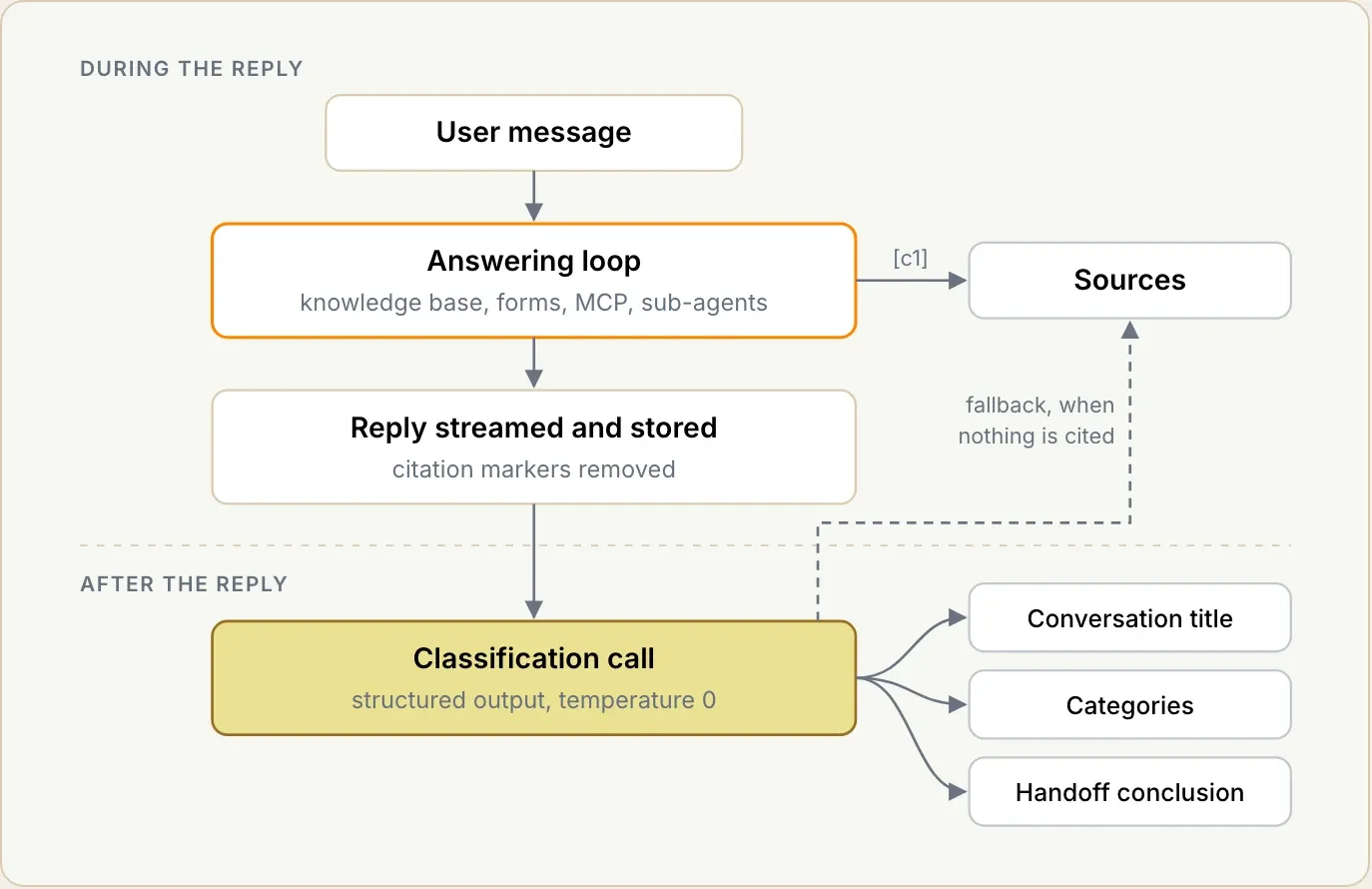
In the use cases we build on the Bayes Platform, this is what we call grounding: the agent relies only on the business rules the institution has written down and on the verified knowledge bases it has been given, not on whatever the model retained from its training.
Suggestion or decision?
The main risk factor is often not technical: it’s a matter of design philosophy. Filter bubbles, or social networks’ pull towards inflammatory content, are encouraged by the business model of platforms that live off attention. In the same way, an algorithm can be used to suggest or to decide.
The same AI can automate decisions on who is eligible for public benefits, which carries a very different level of risk (the EU AI Act classifies such systems as high-risk). It can also suggest, to people going through a hard time, benefits they might not know about. In France, a third of the households eligible for the RSA, the main minimum-income benefit, don’t receive it.
Of course, you have to watch for side effects. A system designed to suggest can become prescriptive in practice, if the proverbial human in the loop ends up following its recommendations without questioning them. A study published in Radiology in 2023 measured it: when the AI proposed the wrong category for a mammogram, even the most experienced radiologists saw their accuracy fall. Hence the importance of thinking about a use case in its context, not in isolation.
People often say you should keep a human in the loop. That’s half the answer. The other half is how you redesign the journey:
- Is the time AI frees up for the caseworker given back to more human contact?
- Beyond explainability, is there an effective way to contest what the AI concludes? That is the whole question of contestability, which research is starting to distinguish from explainability (Freiesleben, Meding and König, 2026). I’d love to hear Stéphan-Eloïse Gras’s view on it.
- Is it about supporting people, or prescribing to them?
And the devil is in the details. Take health care. One AI makes the diagnosis instead of the doctor. Another explains a diagnosis already made to the patient. A third looks over the shoulder of a doctor twelve hours into a shift, and points out what they forgot to check. All three can be instances of the same medical AI agent, but they carry completely different risks and benefits.
Measure, the way institutions are already tested
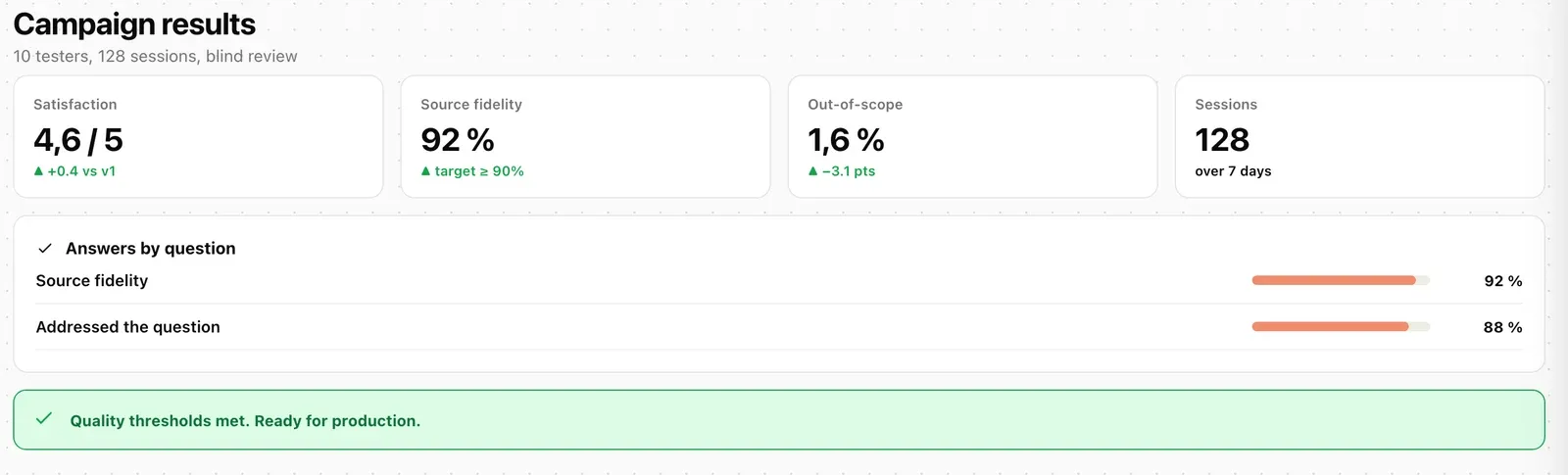
Some blind spots only appear once the tool is running. On a career-guidance use case, for example, we check that the satisfaction rate holds up for every population the service reaches. Those metrics are how we judge whether the recommendations are neutral.
It’s the same principle, in technological form, as the testing campaigns run by SOS Racisme, the French anti-racism NGO: sending out identical CVs that differ only by how foreign the name sounds, and checking whether response rates change. Long before AI, institutions were already tested this way, to check that the neutrality of public service held up in practice. AI needs the same everyday attention.
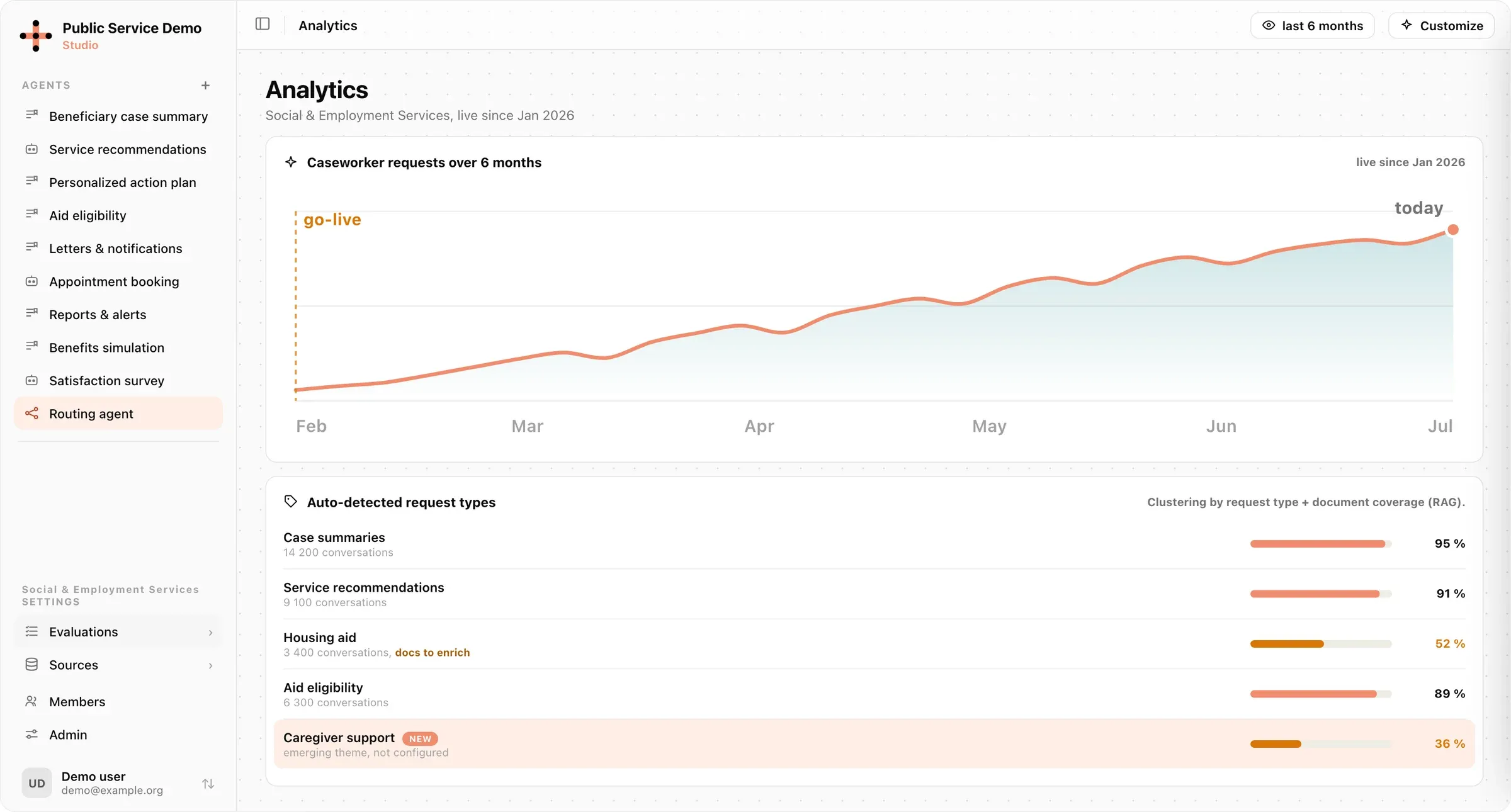
The Bayes Platform is built for this. Every agent goes through an evaluation before launch. Once live, its use is monitored over time, with a categorisation of the topics it handles and a score on the dimensions that matter: hallucination risk, bias, differences in treatment worth examining.
Bring in the people the service is for
Good use cases come up from the field. When we build one, we involve everyone it affects: patients, advocacy groups, frontline staff. Not just whoever is leading the institution’s transformation.
The counter-example is well known. In 2023, NEDA, an American eating-disorder association, had to take down Tessa, its support chatbot, after it gave dieting advice to people living with those disorders. It clearly hadn’t been tested enough with them.
In my experience, organisations fall into the trap mostly when they do AI for the wrong reasons. Either hastily, to cut costs (tempting in today’s economic climate), without a clear vision of the journey to reinvent. Or with the good intentions of someone far from the field, looking for a short-term win.
We don’t take anyone’s word for it either. Not the labs that trained the models, whoever they are, and not our own, even though we build the platform.
When the AI gets it wrong
Mistakes happen. That’s true of AI as much as of people. Danziger, Levav and Avnaim-Pesso showed it in 2011 on more than a thousand parole decisions: right after the lunch break, judges granted parole in 65% of cases, then the rate fell as the session went on, sometimes to zero. The study is famous, and has been debated since.
Machines make mistakes too, just not the same ones: their failure modes aren’t human ones. They don’t get tired, but they can be wrong with total confidence. That’s why the system has to be designed from the start to combine the strengths and weaknesses of both.
Rules rather than zero bias
So zero bias doesn’t exist. But you can define clearly the rules the AI must follow. Those rules aren’t the AI’s to invent: they’re for a human governance, and an organisational one too, to set. And it’s the systems around it, the evaluation before launch, the monitoring in production, the metrics per population, that check every day that it follows them.
That’s how we stay in control.